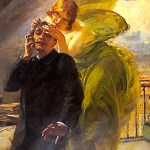
I was delighted to receive in the post this week a copy of the limited edition cd Against Nature, a project I was pleased to help fund via Kickstarter, an album of fifteen songs inspired by Huysmans 1884 novel A Rebours, the project a collaboration between three great talents—music by Orthon, lyrics by Jeremy Reed and vocals by Marc Almond. It is the convergence of four unique creative energies, the fourth being the novel’s author Joris-Karl Huysmans.
A Rebours or Against Nature (a literal translation is ‘against the grain’) was considered a very shocking novel in its time, it is the story of the retreat from society of the aristocratic Jean des Esseintes to a house in the countryside where he devotes his life to aesthetic contemplation, conducting a series of intellectual experiments (a bit like Flaubert’s Bouvard and Pecuchet) while recalling his debauched life in Paris. It is often remembered as the book which contains the tortoise whose shell is encrusted with jewels.
Colin Wilson mentions this striking novel in The Outsider, acknowledging the book’s compelling power which draws the reader into the world of a bored, rich loner and, sometimes much to our discomfort, we vicariously start to enjoy his hedonistic experiments in much the same way that today despite ourselves we may root for Hannibal Lecter, Dexter Morgan or Walter White.
Oscar Wilde read the book on his honeymoon and it changed his life. It was the inspiration for his book The Portrait of Dorian Gray and in that novel A Rebours itself appears in disguise as the book Dorian reads and which leaves him mesmerised: ‘The hero, the wonderful young Parisien . . . became to him a kind of pre-figuring type of himself. And indeed the whole book seemed to contain the story of his whole life, written before he had lived it.’ Wilde’s biographer, Richard Ellman tells us that he knew it was a ‘poisonous book’, nevertheless Wilde drank it as a chaser with the love potions of matrimony.’
It is not hard to see why the trio cultural mavericks, Orthon, Almond and Reed were drawn to this material and were determined to make the album ‘no matter what.’ They have produced a powerful suite of songs not easily forgotten and containing a bravura performance by Marc Almond, surely one of the highpoints of his career. Almond is one of the greatest vocalists of his generation, a performer who has taken a singular path through mainstream pop and decadent fringe, torch song and cabaret, and whose dark chocolate voice conjures up a strange combination of beauty, heartbreak and sleaze. Against Nature is the perfect vehicle for his talent and many times in these songs he pushes his voice triumphantly to its limits, alternately swooning, soaring and whispering, and in songs like ‘The Slice’ performs some outstanding verbal gymnastics, the speed and delicacy of his phrasing being quite astounding.
Jeremy Reed is equally at home in this world which seems a natural haven for him, a place where the hero lives for kicks, where the thrill of the experience is the important thing, a world of rich scents and colours, of sexual androgyny, glamour and grand style, experience which often turns hallucinatory and where the protagonist is sometimes led to acts of cruelty and sadism, and who has learnt to live on the edge. Against Nature contains some of his best lyrics and the power of artistic vision is compelling rendered in songs like ‘The Green Fairy’, a song about the effects of drinking absinthe.
Orthon’s settings are masterly and artfully conjure up the decadent nineties and the piano is beautifully nuanced, and it is the music which gives the songs a special poignancy and saves them from become too histrionic. The music is lush and colourful, a river of dark treacle from which it is impossible to escape. In his soundscapes, Orthon has captured the compelling nature of the material which has a Faustian pull toward damnation.
Pursuing a visionary credo is a dangerous vocation and according to their autobiographies the lives of Reed and Almond have contained a great deal of pain, breakdown and suffering and they have been pushed to fringes of the mainstream, supported for the most part by a core of dedicated fans. In his tribute to Marc Almond, Segmenting the Black Orange, Reed writes: ‘Giving one’s life to one’s art is an isolating and often disparaging experience.’ Genius, however, can turn suffering to great art and this seems to be the impetus behind Against Nature. For this is no mere Baudelairean celebration of decadence, but a self-conscious vindication of the artistic vision.
This is confirmed for me in the magnificent final song, Liturgy, which features a choir, the most beautiful track on the album. It is prayer of renunciation, humility and transformation and I found listening to it deeply cathartic. It is a plea of forgiveness and acceptance of the human and the limited as well as an affirmation of the artistic vision, pursued no matter what. I found the words and music to have an unexpected spiritual undertone. The final verse is performed by Almond with great transcendent power:
I can’t renounce or regret
what I would like to forget
Lord I’ve sunk so low
but I see a violent rainbow
liberate me to humility
Against Nature will be released into the public domain early in 2016 and I’m not holding my breath waiting to hear it toasted in the mainstream media. I want to live with this album a lot longer before I attempted a more detailed critique, but for those who can take it, this is a work of genius, a glorious testament to the power of art, and if you can open your heart to it, it will leave you transformed.
 The Lighthouse by the Sea
I just hope it stays true to the apolical elitism of the novel. If not, what’s the point? What we love about this book is it goes beyond both Marxism and Capitalism, even if it is enslaved by both.
I agree Louis, the appeal of the book is its freakishness and individuality, and this song cycle really does capture that oddity and its creative flame. The elitist spirit of great art is there, but there’s no political subtext to this project.